LeetCode142 Linked List Cycle II
Author: Stefan Su
*Create time: *
Location: New York City, NY, USA
Description Medium
Given the head of a linked list, return the node where the cycle begins. If there is no cycle, return null.
There is a cycle in a linked list if there is some node in the list that can be reached again by continuously following the next pointer. Internally, pos is used to denote the index of the node that tail’s next pointer is connected to (0-indexed). It is -1 if there is no cycle. Note that pos is not passed as a parameter.
Do not modify the linked list.
Example 1
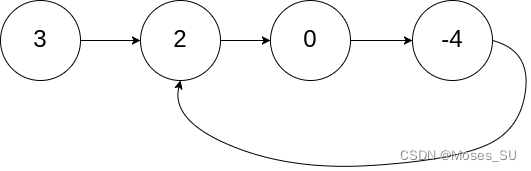
Input: head = [3,2,0,-4], pos = 1
Output: tail connects to node index 1
Explanation: There is a cycle in the linked list, where tail connects to the second node.
Example 2
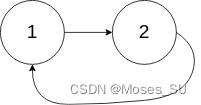
Input: head = [1,2], pos = 0
Output: tail connects to node index 0
Explanation: There is a cycle in the linked list, where tail connects to the first node.
Example 3

Input: head = [1], pos = -1
Output: no cycle
Explanation: There is no cycle in the linked list.
Constrains
- The number of the nodes in the list is in the range
[0, 104]. -105<= Node.val <= 105posis-1or a valid index in the linked-list.
Analysis
Two points
- Check if a linked list is cyclic
- If there is a ring, how to find the entrance to this ring
Details
Check if a linked list is cyclic
You can use the two pointers method to define the
fastandslowpointers respectively. Starting from theheadnode, thefastpointer moves two nodes at a time, and theslowpointer moves one node at a time. If thefastandslowpointers meet on the way, it means that the linked list has a ring.Why do
fastgo to two nodes andslowgo to one node, and if there is a ring, they will definitely meet in the ring instead of being staggered forever?First of all, the first point: the
fastpointer must enter the ring first. If thefastpointer and theslowpointer meet, they must meet in the ring, which is beyond doubt.So let’s see, why the
fastpointer and theslowpointer must meet?You can draw a ring and let the
fastpointer start catching up with theslowpointer at any node.
fastandsloweach take one step further,fastandslowmeetThis is because
fasttakes two steps andslowtakes one step. In fact, compared withslow,fastis a node that is close toslow, sofastmust be able to overlap withslow.If there is a ring, how to find the entrance to this ring
At this point, it can be judged whether the linked list has a ring, so the next step is to find the entry of this ring.
Suppose the number of nodes from the head node to the ring entry node is
x. The number of nodes from the ring entry node to the node where thefastpointer meets theslowpointer isy. The number of nodes from the encounter node to the ring entry node isz. As the picture shows:
Then when they meet: The number of nodes passed by the
slowpointer is:x + y, the number of nodes passed by thefastpointer:x + y + n (y + z), wherenis thefastpointer afterncircles in the ring to meet theslowpointer,(y+z)is the number A of nodes in a circle.Because the
fastpointer walks two nodes at a time, and theslowpointer walks one node at a time, the number of nodes traversed by thefastpointer equals to twice of the number of nodes traversed by theslowpointer:(x + y) * 2 = x + y + n(y + z)Eliminate one on both sides
(x+y):x + y = n (y + z)Because the entrance to the ring is to be found,
xis required, becausexrepresents the distance from the head node to the ring entrance node.So ask for
x, putxalone on the left:x = n (y + z) - y,Then come up with a
(y+z)fromn(y+z). After sorting out the formula, it is the following formula:x = (n - 1) (y + z) + zNote that n must be greater than or equal to 1 here, because thefastpointer needs to travel at least one more circle to meet theslowpointer.What does this formula say?
Let’s take the case where n is 1 as an example, which means that after the fast pointer turns around in the ring, it encounters the slow pointer.
When n is 1, the formula resolves to
x = z,This means that a pointer is set from the head node, and a pointer is also set from the encounter node. These two pointers only go one node at a time, so when these two pointers meet, it is the node of the ring entry.
That is, at the encounter node, define a pointer
index1, and set a pointerindex2at the head node.Let
index1andindex2move at the same time, one node at a time, then the place where they meet is the node of the ring entrance.So what happens if n is greater than 1, that is, the
fastpointer encounters theslowpointer after n circles in the ring.In fact, this situation is the same as when n is 1, and the entry node of the ring can be found by this method, but the
index1pointer turns(n-1)more times in the ring, and then encountersindex2, the meeting point is still the entry node of the ring.
Solution
- Two pointers version
/**
 * Definition for singly-linked list.
 * class ListNode {
 *     int val;
 *     ListNode next;
 *     ListNode(int x) {
 *         val = x;
 *         next = null;
 *     }
 * }
 */
public class Solution {
    public ListNode detectCycle(ListNode head) {
        ListNode fast = head;
        ListNode slow = head;
        while (fast != null && fast.next != null) {
            fast = fast.next.next;
            slow = slow.next;

            if (slow == fast) {
                ListNode index_1 = fast;
                ListNode index_2 = head;
                while (index_1 != index_2) {
                    index_1 = index_1.next;
                    index_2 = index_2.next;
                }
                return index_1;
            }
        }
        return null;
    }
}
Hopefully, this blog can inspire you when solving LeetCode142. For any questions, please comment below.